Registered Investment Advisers (RIAs) as Financial Institutions under the BSA
REGISTERED INVESTMENT ADVISORS | US
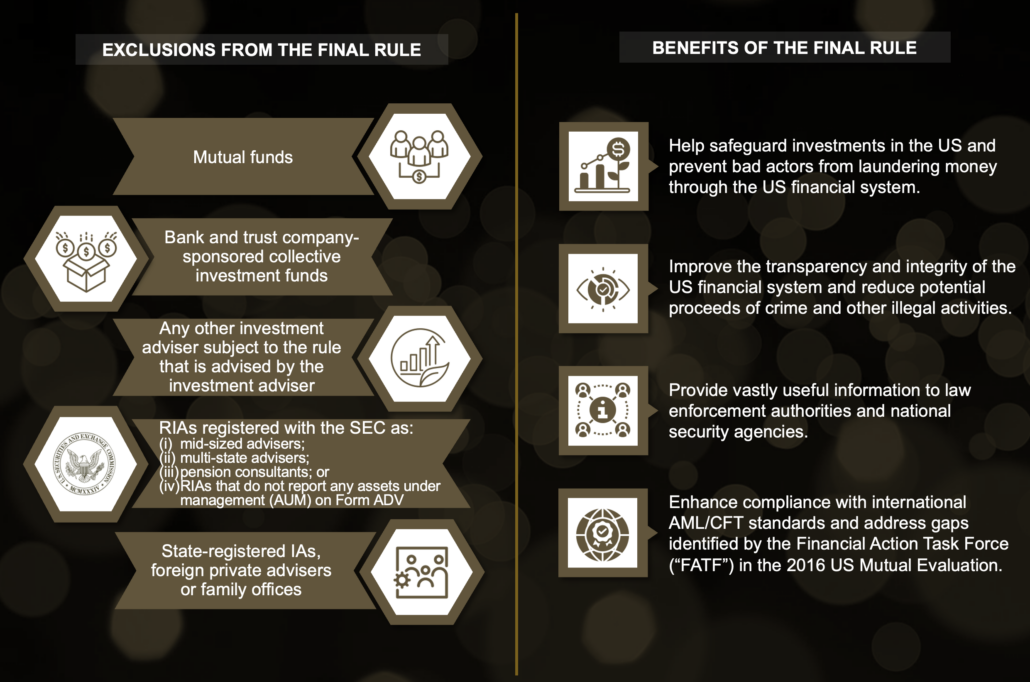
Requirements of the Final Rule for RIAs and Exempt Reporting Advisers (ERAs), Effective January 1, 2028
The Investment Advisers Act of 1940 (Advisers Act), as well as its implementing rules and regulations, is the primary federal framework governing investment advisory activity. Under the Advisers Act, an investment adviser (IA) is a person or firm engaged in the business of providing advice to others or issuing reports or analysis regarding securities.
From the findings of the Investment Advisor Risk Assessment, the Financial Crimes Enforcement Network (FinCEN) issued a Final Rule on August 2024 impacting investment advisers registered with the Securities and Exchange Commission (SEC), also known as Registered Investment Advisers (RIAs), and investment advisers reporting to the SEC as exempt reporting advisers (ERAs), both of which are now included to the definition of a “financial institution” under the Bank Secrecy Act (BSA).
The initial final rule set to go live on January 1, 2026, would have required RIAs and ERAs to implement Anti-Money Laundering and Countering the Financing of Terrorism (AML/CFT) requirements. As of July 21, 2025, FinCEN postponed the implementation of the rule by two years to January 1, 2028.
The CTA vs. the CDD Rule: What is the Difference?
BENEFICIAL OWNERSHIP | US
Financial Crimes Enforcement Network’s (FinCEN) Beneficial Ownership Reporting Requirements under the Corporate Transparency Act (CTA) and the Customer Due Diligence (CDD) Rule
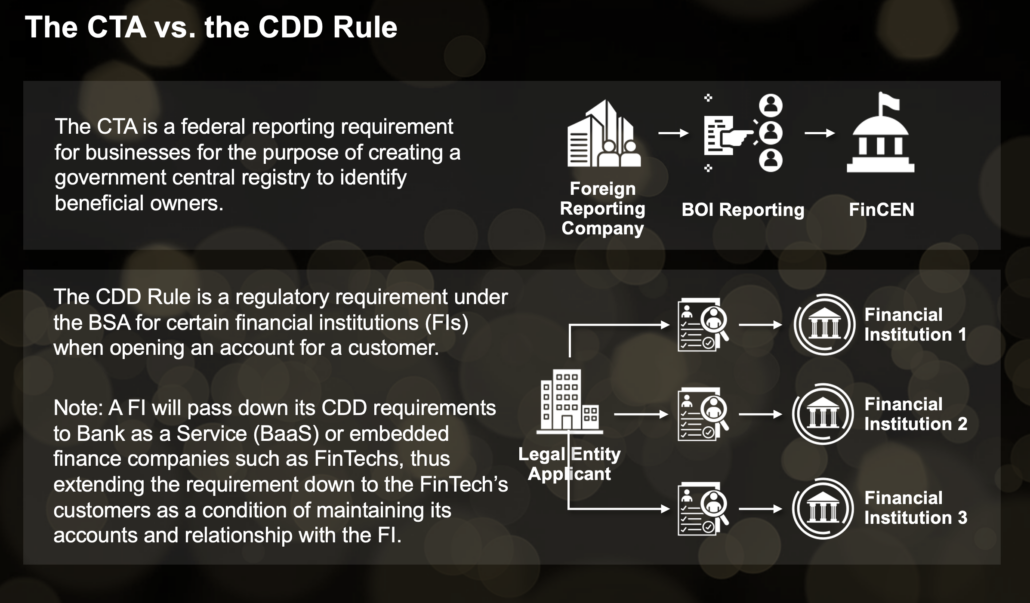
In 2021, the US enacted the CTA, effective January 2024, which required Beneficial Ownership Information (BOI) reporting of certain legal entities to the FinCEN to align with the Financial Action Task Force’s (FATF) Recommendations 24 and 25 regarding the transparency and beneficial ownership of legal persons and arrangements.
The CTA initially required most US companies, absent an exemption, to report their beneficial owners’ details to FinCEN. However, due to public criticism and legal challenges, in March 2025, FinCEN issued an interim final rule, which redefined “reporting companies” as “foreign reporting companies,” effectively exempting US companies and persons from BOI reporting requirements to FinCEN.
Since its enactment in January 2021, the CTA has undergone multiple revisions, but as of March 2025, the CTA only requires foreign reporting companies to report BOI to FinCEN, or the individuals who ultimately own or control them. The CDD Rule, on the other hand, requires covered financial institutions to identify and verify the identity of companies’ BO when they open accounts. While both regimes require reporting and collecting BOI, the CTA and the CDD Rule are independent requirements and maintain different audiences. As such, satisfying one does not satisfy the other.
The Key Aspects of Regulatory Reporting and Recordkeeping Requirements

REGISTERED INVESTMENT ADVISORS | US
Reporting Requirements for Covered Financial Institutions under the BSA
The Bank Secrecy Act of 1970 (BSA) is the primary body of law and regulation addressing anti-money laundering (AML) in the United States (US). It requires regulated financial institutions (FIs) to detect, prevent, and report potential money laundering to government agencies.
In today’s complex financial landscape, regulatory reporting serves as a cornerstone of safeguarding the US financial system against money laundering, fraud, terrorist financing, and other illicit activities. For US-based FIs, understanding and complying with BSA is crucial. Moreover, most FI BSA compliance failures resulting in public civil penalties include noncompliance with reporting requirements.
Other Relevant Spotlights
SANCTIONS | US
Geolocation is More Than Just a Postcode
A Spotlight on Geolocation and IP Address Screening to Maintain Compliance with the Office of Foreign Assets Control (OFAC)
CYBERSECURITY
The Understanding and Defending Against Social Engineering Attacks
A Spotlight on How You Can Protect Your Organization From Social Engineering Attacks
CYBERSECURITY
The Rise of Advanced Passwordless Authentication
A Spotlight on the Transition from Traditional Authentication to Passwordless Authentication Methods

RISK | STRATEGY | CYBER COMPLIANCE MANAGEMENT