2022 OFAC Sanctions Annual Report
Types of OFAC Sanctions Programs
Sanctions programs vary in scope and may encompass prohibitions at a country level, which is why OFAC does not maintain an actual list of countries that US persons cannot do business with. Instead, OFAC maintains a number of Sanctions Programs, which can be comprehensive, selective, geographically oriented or individuals or entities focused. There are currently 39 Sanctions Programs, which can be categorized into three (3) categories:
- Targeted Sanctions: Targeted sanctions involve blocking of property, freezing of assets, certain trade restrictions and other prohibitions on specific individuals or entities listed on OFAC’s SDN List. Additionally, targeted sanctions also consider the 50% Rule, which implies that entities which are 50% owned by sanctioned parties, whether directly or indirectly, are also subject to sanctions regardless if they appear on the SDN List or not. This may be applicable to a country or a theme, such as narcotics or terrorism, cyber, foreign interference to US elections, human rights abuse, and transnational crimes.
- Comprehensive Sanctions: Comprehensive sanctions impose broad restrictions, which prohibit almost all transactions and business activities associated to regions or countries.
- Sectoral Sanctions: Sectoral sanctions are not subject to blanket prohibitions and are imposed only to specific sectors of a sanctioned country or regime.
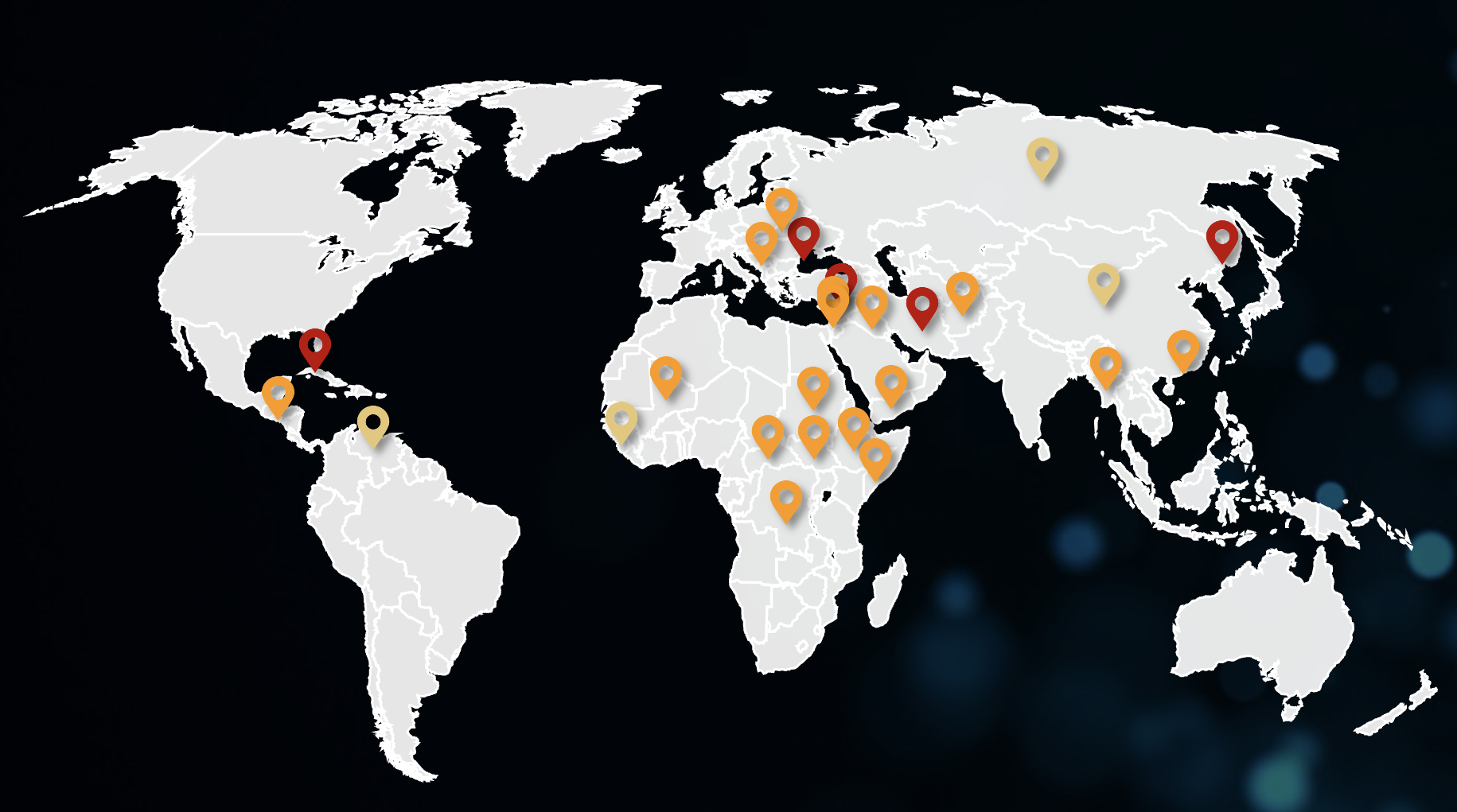
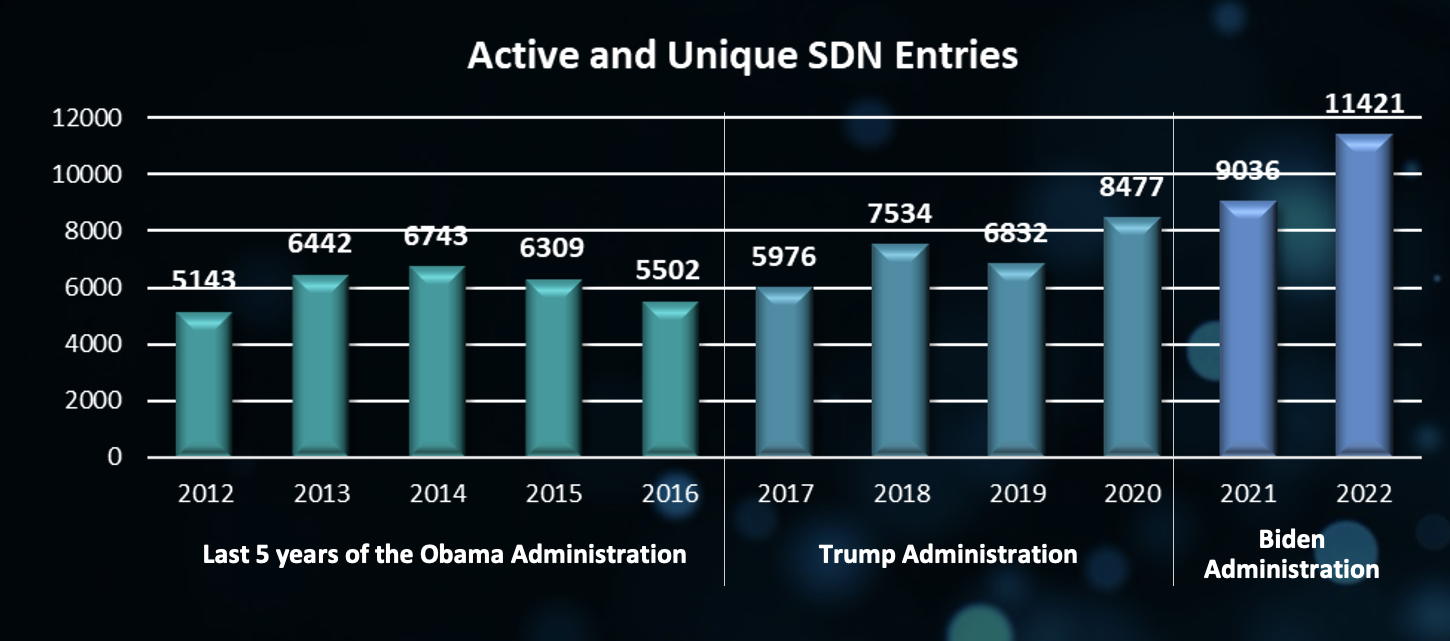
President Obama, Trump, and Biden Leverage Sanctions
Each OFAC sanctions program is based on different national security and foreign policy goals and may originate either from the executive or the legislative branch. The President launches the process by the issuance of an EO that declares a national emergency to extraordinary or unusual threats to national security or foreign policy.
EOs allow the President special powers to regulate commerce related to such threats for a period of a year, unless extended or terminated by a joint resolution of Congress or amend sanctions programs. Sanctions have steadily increased across the Obama, Trump, and Biden administrations. Notably, during the past 10 years across the three administrations, sanctions increased 122%, clearly indicating the executive branch continues to leverage sanctions as a foreign policy tool.
For more insight on OFAC sanctions programs, download our 2022 OFAC Sanctions Annual Report:
Need to Conduct OFAC Sanctions Screening?
A Streamlined Sanctions Program Service from Program Management, Screening, and Executive Reporting to Voluntary Disclosures
OFAC sanctions screening involves screening customers, counterparties, employees, vendors, transactions, etc. across multiple lists with individuals and entities being frequently added and removed. All US persons must comply with OFAC’s regulations.
While OFAC provides an online search tool for simple screening, vendors often provide exhaustive and expensive screening solutions. As the OFAC lists are updated, new business lines are launched or acquired, new foreign markets are opened, goods exported, or complying with ongoing bank and payment partner contractual responsibilities, screening gaps can form increasing the likelihood of violating OFAC’s regulations. Certain individual and entity populations may need to be screened or re-screened, preemptively or reactively, potential matches reviewed and dispositioned, documented, and exact matches reported, if applicable.
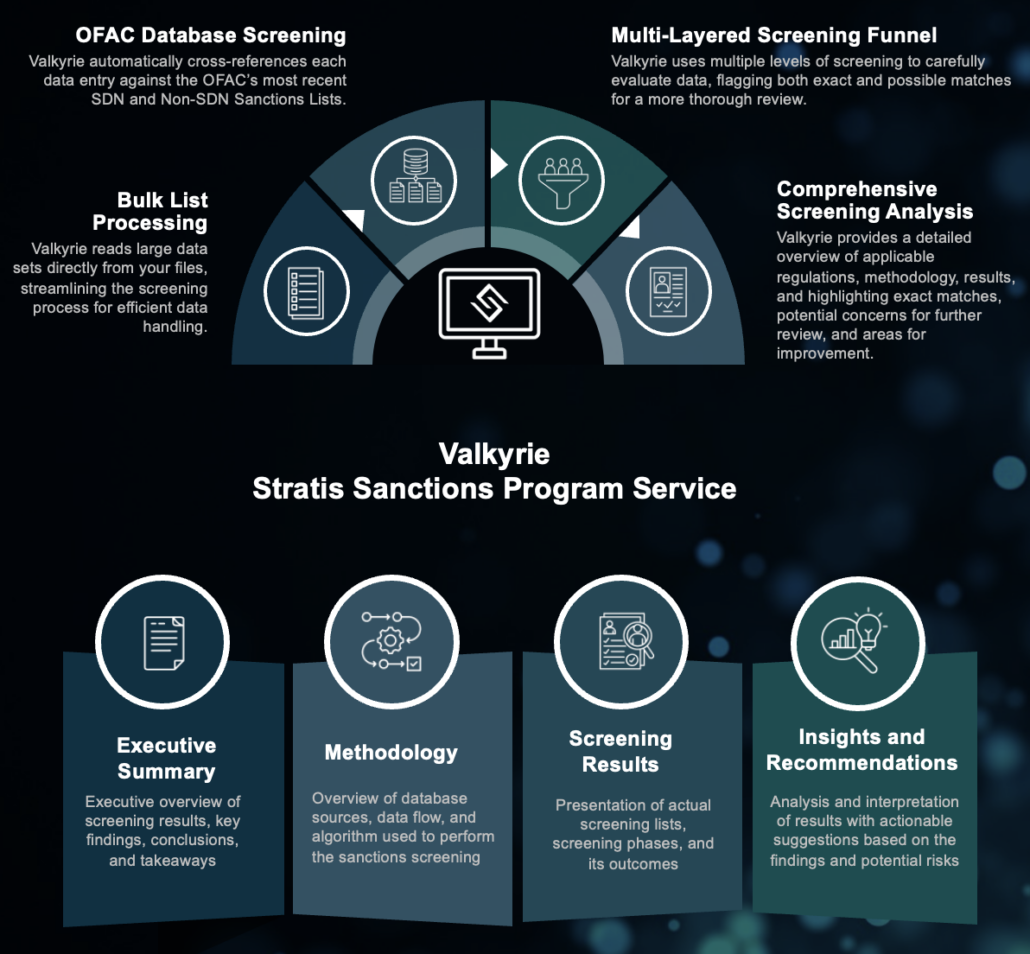
As a result, Stratis has developed Valkyrie, a streamlined sanctions program service designed to help businesses meet sanctions compliance standards with ease, which includes screening, monitoring, dashboarding, and reporting. Stratis can help you with:
- Sanctions program design, risk assessments, and program management
- Customer, vendor, and employee population screening and monitoring
- Subsidiary, affiliate, and foreign-located entity screening and monitoring
- Pre-and-post mergers and acquisitions due diligence screening
- Executive management and board of directors training
- Export clearance
For assistance with conducting OFAC sanctions screening using Valkyrie, contact us:
Need to Develop a Sanctions Compliance Program?
Build a Scale-Appropriate Sanctions Compliance Program
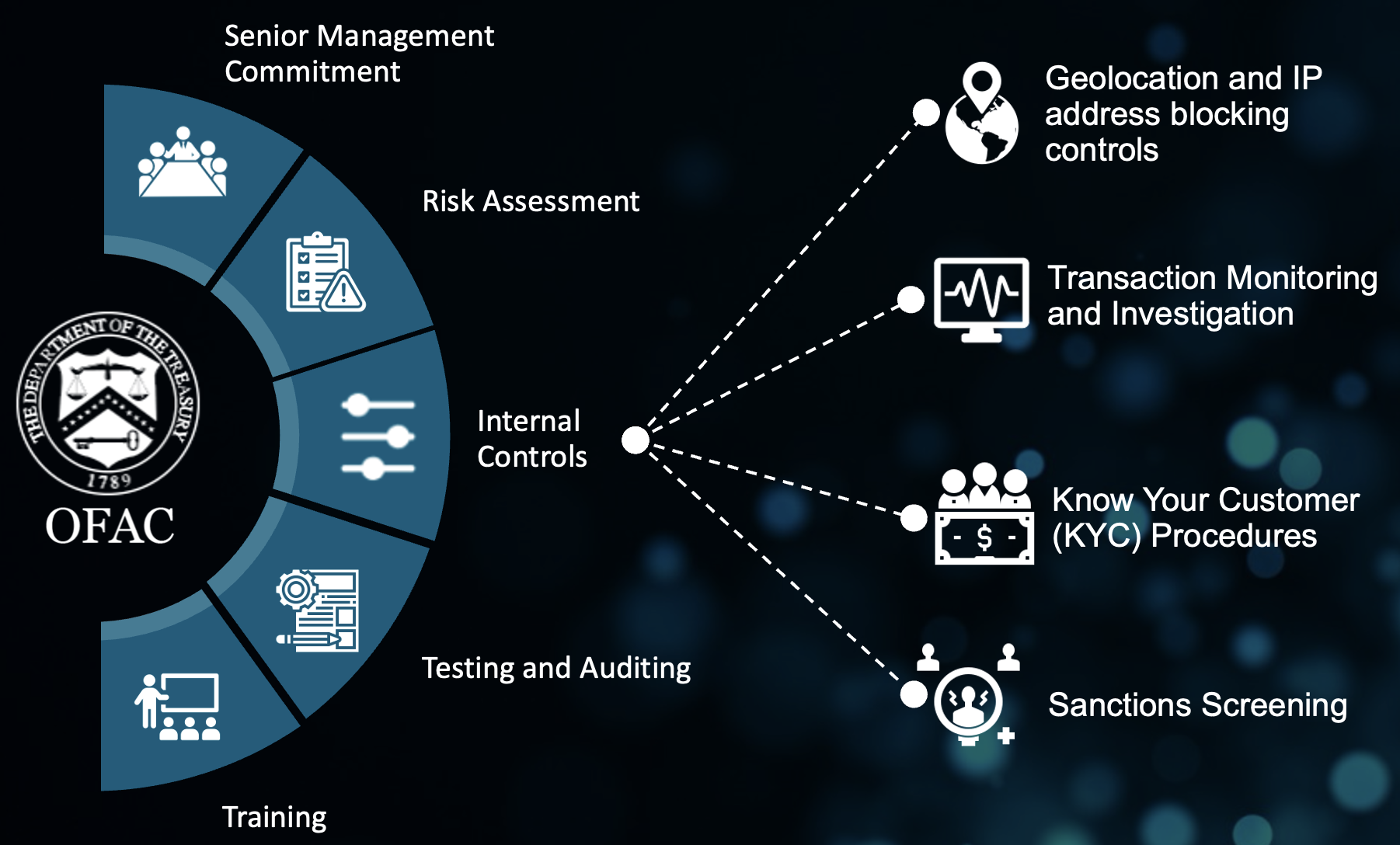
OFAC strongly encourages organizations subject to US jurisdiction, as well as foreign entities that conduct business in or with the US, US persons, or using US origin goods or services, to employ a risk-based approach to sanctions compliance by developing, implementing, and routinely updating a Sanctions compliance program (SCP).
While each risk-based SCP will vary depending on a variety of factors—including the company’s size and sophistication, products and services, customers and counterparties, and geographic locations—each program should be predicated on and incorporate at least five (5) essential components of compliance: (1) management commitment, (2) risk assessment, (3) internal controls, (4) testing and auditing, and (5) training.
Since the SCP guidance was issued in 2019, OFAC has identified in each public enforcement action that maintaining an SCP is considered a mitigating factor when determining penalties for non-compliance with sanctions laws and regulations. Moreover, OFAC subpoenas include documentation related to the five components of a SCP.
Long gone are the days where sanctions were considered historical embargoes and basic awareness of countries/regions to avoid doing business with. Company’s need to understand their sanctions risk, assess such risk, establish appropriate controls to mitigate the risk, train personnel, and include in company-wide testing processes.
For assistance with developing, scaling, or optimizing an OFAC sanctions compliance program, contact us:
OFAC Reporting Guides
OFAC encourages any individual or entity who may have violated US sanctions regulations to self-disclose apparent violations. Voluntary self-disclosures must include or to be submitted as a follow through within a reasonable period of time, which sufficiently provides a complete understanding of circumstances of the apparent violation/s.
OFAC requires covered persons or entities to fully comply with reporting obligations on blocked or unblocked property and rejected transactions. The initial reporting is required within 10 business days of the action or occurrence date with an Annual Report of Blocked Property (ARBP) to be filed by September 30.
AML AND SANCTIONS PROGRAMS
PART 504 CERTIFICATION | NEW YORK
All NYS DFS Covered Entities must establish and maintain transaction monitoring and OFAC sanctions watchlist filtering programs and are required to annually certify compliance by April 15 with Part 504.

RISK | STRATEGY | CYBER COMPLIANCE MANAGEMENT