AI Agents 101: How Agents Think, Act, and Drive Workflows
Intelligence in Motion: Mapping AI Agent Evolution
From smart to strategic, the artificial intelligence (AI) evolution started as rule-bound systems crunching numbers and shifted to creative tools that write, draw, and code. Presently, Agentic AI is an emerging development because it moves beyond pattern recognition and content creation of Traditional and Generative Ais. The shift focuses on autonomous decision-making and goal execution. As answering questions and generating texts slowly become the norm and legacy; acting with purpose, adapting to environments, and coordinating complex tasks are at the forefront.
AI agents can be helpful to many industries around the globe. As we are in the age of Agentic AI, it combines autonomy and intelligence—allowing them to act, learn, and collaborate in real-world environments. AI agents adapt quickly when needed to handle complex, high-volume, and high-risk situations. Below are non-exhaustive use cases where industries can embrace the self-optimizing ecosystem of agent AI. From the floors of factories, hospitals, or financial markets, AI agents can reshape the backbone of global industries creating a ripple effect of efficiency and resilience.

AI Governance and Guardrails: Safeguarding Ethical Operations and Regulatory Compliance

Accountability, Policy, and Evidence for Compliance
AI governance is the system of roles, policies, and checks that ensure AI is used safely, ethically, and in compliance with emerging laws so it remains trustworthy and under human control. AI will fall into traditional, but adaptable frameworks: Who is in charge? What rules are followed? How are they checked? and What happens when something goes wrong?
AI agents can process large and a wide-range of datasets to identify threats and anomalies, no matter how complex, to automate repetitive tasks, and to provide highly contextual insights for a faster and more precise risk scoring. While AI risk assessments focus on providing accurate, unbiased and fair classifications and recommendations, output quality, and still requires human review, AI agents introduce action risk, which refers to the consequences of autonomous decisions and actions that are taken without human intervention.
AI Deployment: Implementing Controls throughout the AI Agent Lifecycle
Pre-Deployment and Post-Deployment Controls
A crucial component in the governance of AI is the application of corresponding controls to each stage of its lifecycle. Such controls or guardrails, together with the proper governance, policies and risk management framework, are necessary to ensure the AI agent’s operational trustworthiness, safety and responsibility. AI agents must go through comprehensive pre-deployment testing and validation to ensure reliability and compliance, followed by continuous monitoring and assurance upon deployment, as well as post-deployment, to manage risks and maintain performance.
Pre-deployment activities ensure AI systems are responsibly designed, tested, and validated, establishing strong governance, data integrity, and risk controls. Post-deployment activities include oversight of AI agents across multiple, complementary monitoring layers that ensure reliability, transparency, and regulatory defensibility over time. Inherently, internal and external audit reviews will seek to ensure every AI agent or model has comprehensive, version-controlled documentation proportional to its risk level and business impact.

AI Model Validation: Risk to Reliability through Quality Assurance Standards
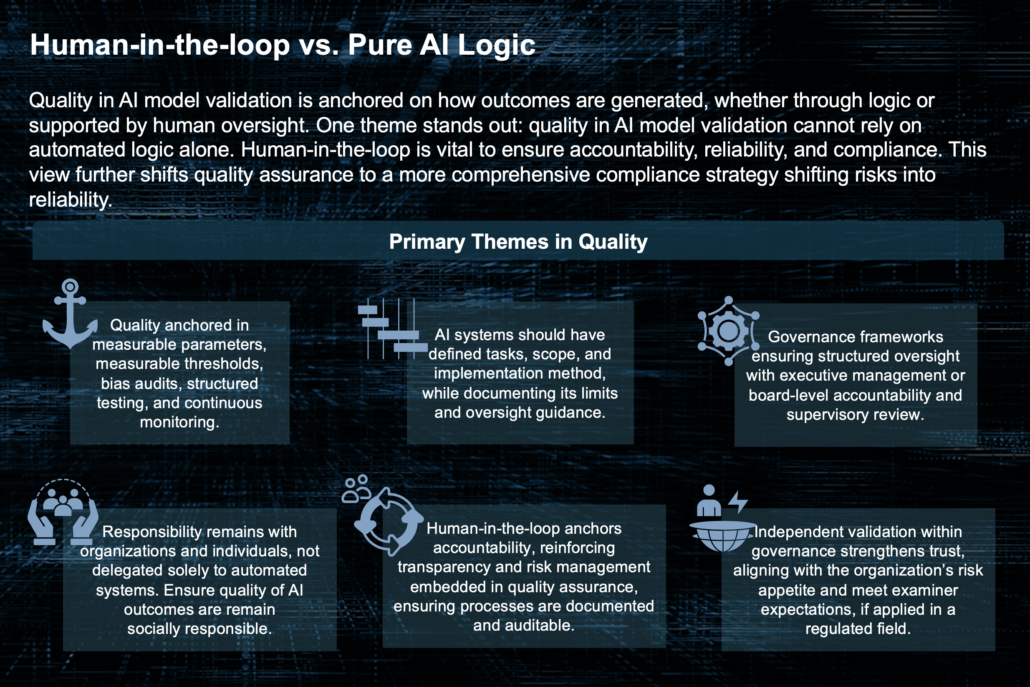
Shifting Risk to Reliability through Quality Assurance Standards, Risk Management, and Compliance in AI Model Validation
AI Model Validation is the independent assessment of models used to ensure they are accurate, reliable, and aligned with industry best practice. The National Institute of Standards and Technology (NIST) introduced the AI Risk Management Framework (AI RMF), outlining core functions that guide institutions with oversight, identify risks, thresholds setting, and continuously monitoring. Alongside these functions are the characteristics of trustworthy AI which serve as parameters against which models must be validated.
Building a framework through embedded parameters from NIST create a unified charter where quality is not compromised by speed and oversight is not sacrificed for automation. An ideal framework transforms blockers into solutions and converge to deliver statutory-ready assurance.

RISK | STRATEGY | CYBER COMPLIANCE MANAGEMENT