Valkyrie – A Stratis Sanctions Program Service
A Streamlined Sanctions Program Service from Program Management, Screening, and Executive Reporting to Voluntary Disclosures
OFAC sanctions screening involves screening customers, counterparties, employees, vendors, transactions, etc. across multiple lists with individuals and entities being frequently added and removed. All US persons must comply with OFAC’s regulations.
While OFAC provides an online search tool for simple screening, vendors often provide exhaustive and expensive screening solutions. As the OFAC lists are updated, new business lines are launched or acquired, new foreign markets are opened, goods exported, or complying with ongoing bank and payment partner contractual responsibilities, screening gaps can form increasing the likelihood of violating OFAC’s regulations. Certain individual and entity populations may need to be screened or re-screened, preemptively or reactively, potential matches reviewed and dispositioned, documented, and exact matches reported, if applicable.
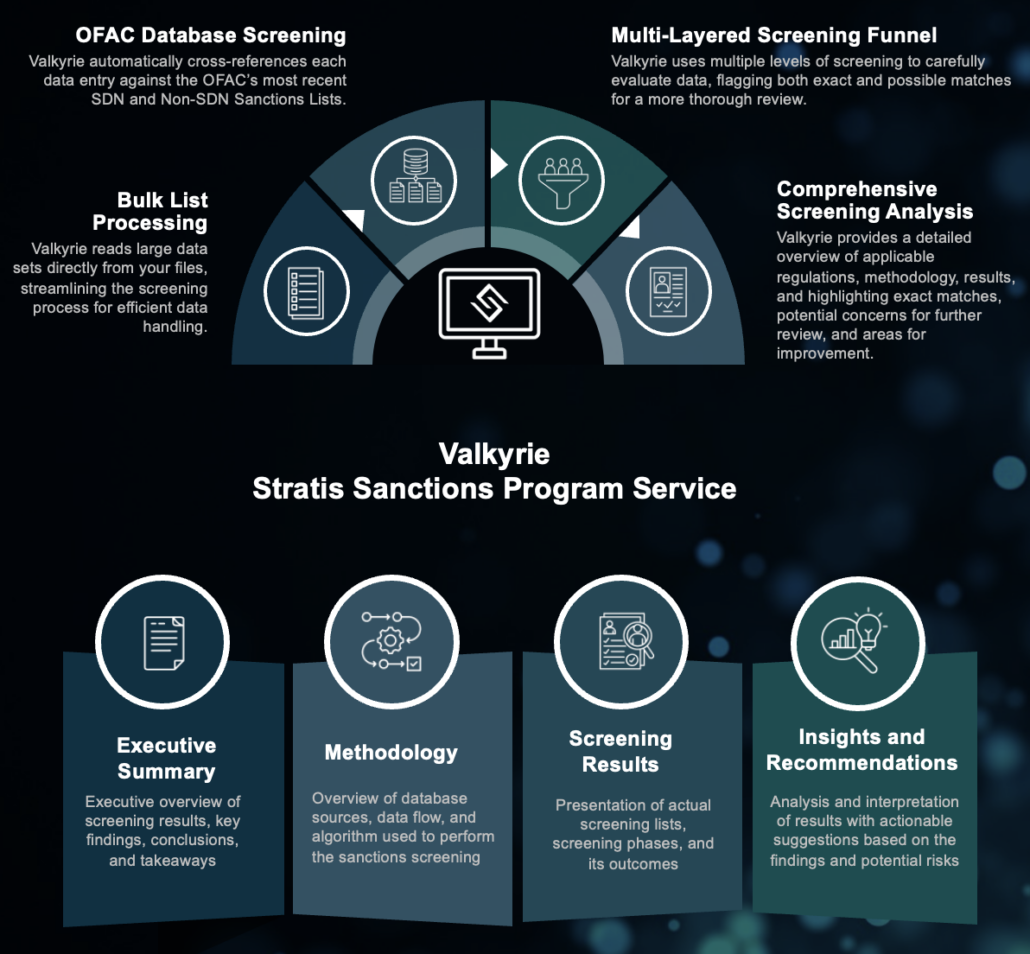
As a result, Stratis has developed Valkyrie, a streamlined sanctions program service designed to help businesses meet sanctions compliance standards with ease, which includes screening, monitoring, dashboarding, and reporting. Stratis can help you with:
- Sanctions program design, risk assessments, and program management
- Customer, vendor, and employee population screening and monitoring
- Subsidiary, affiliate, and foreign-located entity screening and monitoring
- Pre-and-post mergers and acquisitions due diligence screening
- Executive management and board of directors training
- Export clearance
For assistance with conducting OFAC sanctions screening using Valkyrie, contact us:
An OFAC Sanctions Compliance Program Mitigates Business Risk
Build a Scale-Appropriate Sanctions Compliance Program
OFAC strongly encourages organizations subject to US jurisdiction, as well as foreign entities that conduct business in or with the US, US persons, or using US origin goods or services, to employ a risk-based approach to sanctions compliance by developing, implementing, and routinely updating a Sanctions compliance program (SCP).
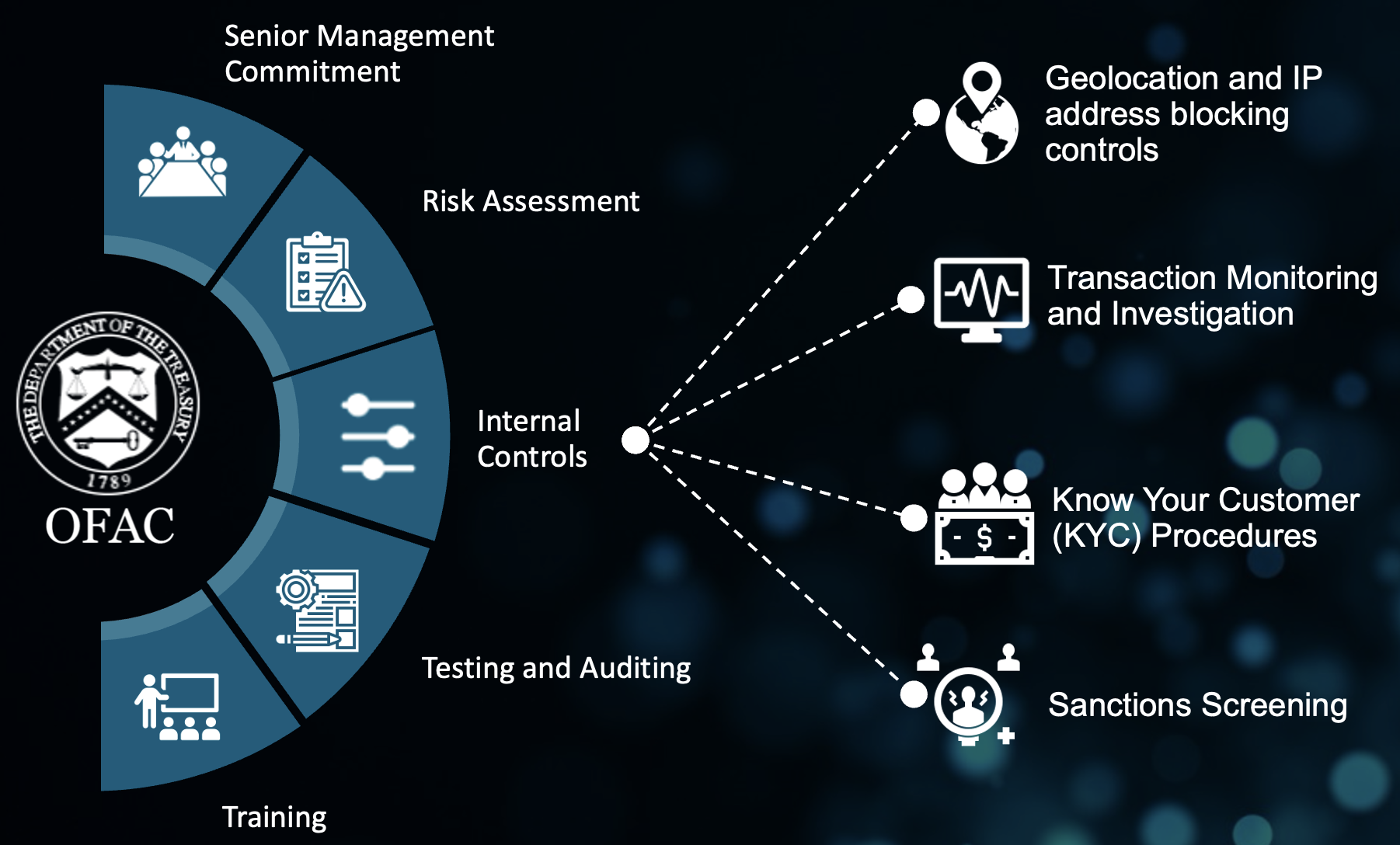
While each risk-based SCP will vary depending on a variety of factors—including the company’s size and sophistication, products and services, customers and counterparties, and geographic locations—each program should be predicated on and incorporate at least five (5) essential components of compliance: (1) management commitment, (2) risk assessment, (3) internal controls, (4) testing and auditing, and (5) training.
Since the SCP guidance was issued in 2019, OFAC has identified in each public enforcement action that maintaining an SCP is considered a mitigating factor when determining penalties for non-compliance with sanctions laws and regulations. Moreover, OFAC subpoenas include documentation related to the five components of a SCP.
Long gone are the days where sanctions were considered historical embargoes and basic awareness of countries/regions to avoid doing business with. Company’s need to understand their sanctions risk, assess such risk, establish appropriate controls to mitigate the risk, train personnel, and include in company-wide testing processes.
For assistance with developing, scaling, or optimizing an OFAC sanctions compliance program, contact us:
Executive and Board Training Increases Sanctions Awareness
Executive and Board Training Enhances Knowledge on How Sanctions Impact Business Operations
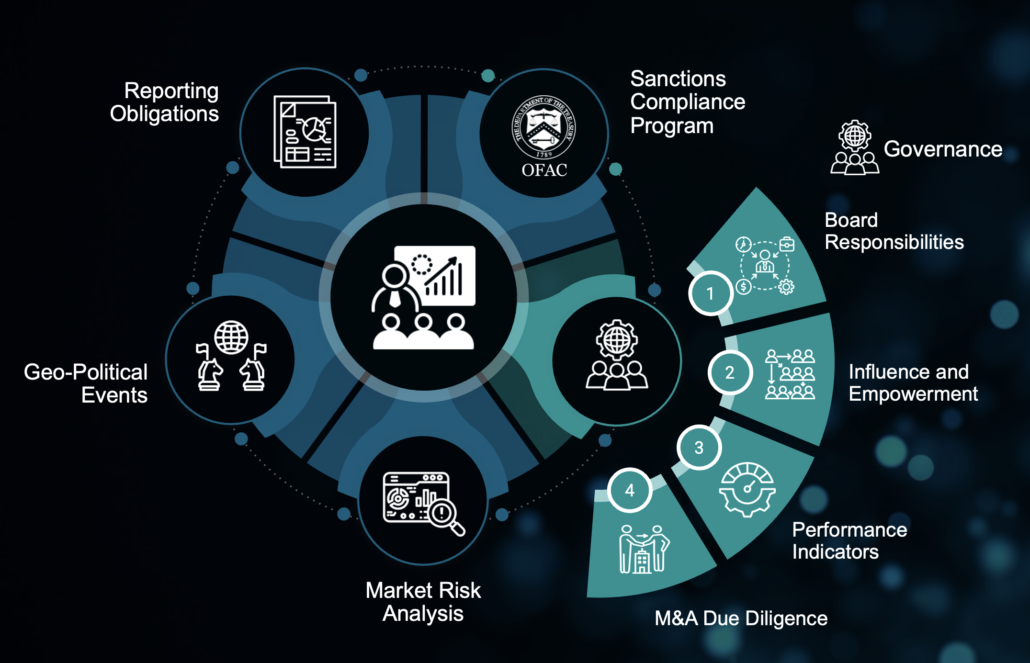
The commitment from senior management is the first pillar of an effective sanctions compliance program (SCP) and a strong culture of compliance waterfalling from leadership will both drive and support internal adherence and behavior.
In today’s volatile geopolitical climate and with the sanctions landscape undergoing significant changes in the last five years, understanding and implementing an effective SCP is no longer industry-specific or limited to just a compliance or legal matter. Rather, sanctions awareness is now a strategic initiative that can have day-to-day implications on business operations, customer acquisition and retention, operating and transacting bank accounts, and global operations.
As a key step in ensuring senior management commitment and accountability, board members and executives should undergo sanctions training at least once a year, not to be an expert on sanctions and the laws associated to it, but to maintain an understanding of the sanctions frameworks, control systems and oversight, and to remain informed of regulatory updates. With this, leaders can continue to properly assess, strategize and navigate through sanctions exposures and risks.
From fundamentals to customized content, Stratis can design and deliver board or executive training suitable for your firm’s business model and size, risk profile and culture. Additionally, Stratis incorporates unique market insights that will assist the leadership team to devise practical and actionable steps towards a stronger sanctions compliance and risk management program.
For assistance with a specialized executive and board training session on OFAC sanctions and its impact on business operations, contact us:
2025 OFAC Sanctions Annual Report Reveals Increase in Iranian Sanctions

In 2025, the US Increased its Crackdown on Oil Sanctions Evasion Against Iran
OFAC publishes a list containing individuals, groups or entities designated under sanctions programs, called the SDN List. This list also includes companies controlled or owned by, or acting for or on behalf of, sanctioned parties or targeted countries. There is no predetermined schedule for updates to the list and entries are added, changed or removed, as necessary.
Based on the average of 2020 to 2024, a 130% increase was identified in 2025 for sanctioned vessels related to Iranian sanctions. These vessels were believed to have been assisting Iran evade oil sanctions and transporting and trading Iranian petroleum, primarily to Asia, Russia and China, through deceptive and obscured shipping practices, and through operations under flags of convenience. Such action is meant to deprive Iran of revenue from its petroleum commodities mainly used to fund and advance its military, weapons and nuclear programs.
Shifting to 2026, on February 2026, the US and Israel launched surprise airstrikes around Tehran and multiple cities in Iran, with Supreme Leader Ali Khamenei and other Iranian officials, and even civilians, as casualties, which is known as the US-Israel War with Iran. As a response, Iran set missile and drone attacks against Israel and on US military bases and US-allied countries in the Middle East.

Iran-related OFAC Designations Significantly Increased in 2025 under the New Trump Administration
Each US President has faced various world events during their administration with President Biden as the sitting President during both the Russo-Ukrainian War of 2022 and Isreal-Hamas War of 2023, which remains ongoing. By the end of President Biden’s term, sanctions increased by almost 90%. Meanwhile, a slow down on Russia and a shift to Iran, narcotics trafficking and terrorism are key themes during President Trump’s first year in his current term, showing only a 7% increase compared to 2024 when previous years multiplied by more than 20% year on year since 2021.
2025 showed a notable shift and recalibration in sanctions priorities, ending the year with only more than 1,900 new and unique designations. Although Russia and Ukraine sanctions regimes remain in effect and intact, more than a 50% decline in the volume of designations was evident since 2022. Focus strikingly shifted to Iran, terrorism, transnational criminal organizations (TCOs), and narcotics trafficking, with the imposition of financial and export control sanctions in pursuit of US foreign policy and security goals. Relief was also seen in several regimes, with the revocation of West Bank and Syria sanctions in January and June respectively, and the reduction of Balkans designations in October.
For more insight on OFAC sanctions programs, download our 2025 OFAC Sanctions Annual Report:
OFAC Reporting Guides
OFAC encourages any individual or entity who may have violated US sanctions regulations to self-disclose apparent violations. Voluntary self-disclosures must include or to be submitted as a follow through within a reasonable period of time, which sufficiently provides a complete understanding of circumstances of the apparent violation/s.
OFAC requires covered persons or entities to fully comply with reporting obligations on blocked or unblocked property and rejected transactions. The initial reporting is required within 10 business days of the action or occurrence date with an Annual Report of Blocked Property (ARBP) to be filed by September 30.
AML AND SANCTIONS PROGRAMS
PART 504 CERTIFICATION | NEW YORK
All NYS DFS Covered Entities must establish and maintain transaction monitoring and OFAC sanctions watchlist filtering programs and are required to annually certify compliance by April 15 with Part 504.

RISK | STRATEGY | CYBER COMPLIANCE MANAGEMENT