Part 2 – Mind the Gap: Geographic Targeting Orders (GTOs) Serve as a Temporary Solution for Non-Financed Residential Real Estate Transactions
The USA PATRIOT Act Real Estate Exemption: A Loophole in the Fight Against Illicit Finance
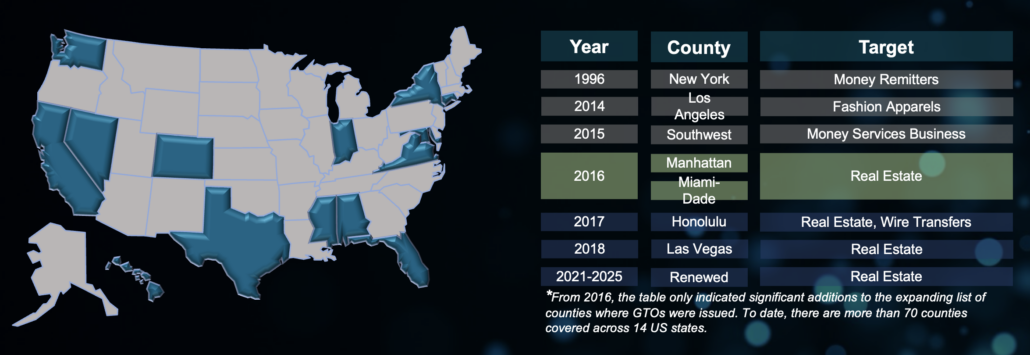
In an attempt to close the loop, since the USA PATRIOT Act was enacted, the Financial Crimes Enforcement Network (FinCEN) has issued more than 20 successive Geographic Targeting Orders (GTOs) to Covered Businesses, typically those serving as agents of title insurance companies. These temporary directives require enhanced reporting to FinCEN on all-cash purchases of residential real-estate by legal entities in more than 30 US counties. A universal approach was attempted with the Residential Real Estate Rule of 2024 (RRE Rule), only to be withdrawn in March 2026 due to legal challenges.
GTOs Shift Focus from Money Services Businesses to Real Estate
GTOs originated under the BSA as a tool to monitor cash transactions in geographic locations tied to drug trafficking and money laundering. In the early years, GTOs were used in counties to monitor large cash deposits and currency exchanges linked to narcotics trafficking with money services businesses (MSBs) such as check cashers and money transmitters in high-risk areas. 2016 marked a shift to near exclusive use of GTOs covering agents of title insurance companies for all-cash purchases of luxury residential real estate by legal entities in select markets such as Manhattan, Miami, and Los Angeles.
With the Customer Due Diligence (CDD) Final Rule issued on May 11, 2016 and effective on May 11, 2018, GTOs supplemented the real estate industry gap on certain non-financed residential real estate transactions requiring the identification of a beneficial owner, i.e., an individual who, directly or indirectly, owns 25% or more of the equity interests of the purchaser. Prior to 2016, all non-financed residential real estate transactions created an opportunistic blind spot for illicit finance: No recordkeeping and reporting requirements such as maintaining an AML program, beneficial ownership identification and verification, and suspicious activity reporting (SAR) reporting.
Minding the [Regulatory] Gap
For 25 years, the USA PATRIOT Act stood as the cornerstone of America’s AML regime, yet its exemption of real estate professionals created a blind spot that invited abuse. Shell companies became the vehicle of choice for concealing wealth, from Russian senators and Mexican governors buying multimillion‑dollar condos at the Time Warner Center to Malaysian elites tied to the 1MDB scandal laundering billions through Beverly Hills mansions and financing Hollywood films like The Wolf of Wall Street.
Laundering money through residential real estate involves turning the proceeds of crime into the use or ownership of real property assets. Non-financed residential real estate provides an opportunity to park illicit funds into a high-value purchase, whether beach front condominiums or single-family homes, that can be utilized in the placement, layering, and integration stages of money laundering.
In essence, they are ‘cash hogs’ as residential real estate is considered a person’s single most valuable purchase of their lifetime, valuations fluctuate and are market based, can be short- or long-term strategies, and are attractive assets to place funds into foreign jurisdictions.
A non-financed transaction typically follows a basic purchase structure that consists of an offshore shell company, an LLC, serving as the owner of the property with a nominee such as a lawyer serving as the power of attorney as the individual on all documentation. The structure keeps at arms length the true owner and source of funds.

As noted by the Government Accountability Office’s (“GAO”) “Anti-Money Laundering-FinCEN Should Enhance Procedures for Implementing and Evaluating Geographic Targeting Orders” Report published on July 2020, the GAO confirmed that FinCEN’s stopgap, the GTOs, though useful, suffered from weak oversight and delayed enforcement, underscoring how the gap persisted for decades.
GTOs Attempt to Close the Gap Anonymous Real Estate Transactions
FinCEN issued the real estate GTOs shortly after The New York Times series entitled “Towers of Secrecy,” first published on February 7, 2015, which exposed how shell companies were used to anonymously buy luxury real estate. To counter, the GTOs required title insurers to identify the beneficial owners behind all‑cash purchases in Manhattan and Miami, marking the first federal attempt to pierce the veil of secrecy in US residential real property markets.
Over time, the GTO reporting thresholds dropped from $3 million to $300,000 USD, coverage expanded to major cities nationwide, and new payment methods like wire transfers and virtual currency were added. GTOs remain limited and lack a universal approach. In 2024, the RRE Rule sought to close the loop starting March 1, 2026; however, the RRE Rule was vacated on March 19 and is no longer enforceable.
US AML Laws on Real Estate Lag Behind other Key Jurisdictions
While the US relied on GTOs from 2016 onwards, other jurisdictions already established permanent AML obligations of their real estate industry years earlier. Although the RRE Rule sought to institutionalize these obligations nationwide, its withdrawal in 2026 meant the recordkeeping and reporting requirements remain unresolved and the US lags other Financial Action Task Force (FATF) members and regions. As of today, persons involved in US real estate closings and settlements are not covered under the BSA.

The Cast of Compliance: Who Plays What Role?
At present, FinCEN’s GTOs only provide compliance of certain title insurers in select markets. The RRE Rule was intended to institutionalize and expand the obligations nationwide shifting the responsibility to a broader fashion. Title insurers are the sole compliance gatekeepers under GTOs. They are required to collect and report beneficial ownership information for certain non-financed residential real estate purchases made by legal entities.

RRE Rule Withdrawal Leaves US Stuck with Limited Purpose GTOs
As the USA PATRIOT Act approaches its 25th anniversary, GTOs stand as evidence of its enduring influence. They represent the US’ effort to attempt to close a loophole that allowed billions of dollars in illicit funds to flow unregulated into US residential real property markets. While the GTOs embody the spirit of the USA PATRIOT Act, extending transparency to a sector that had long avoided oversight, they are limited in scope and duration and lack the full force and effect of a dedicated law to close the loophole, universally.
The RRE Rule identified that FinCEN believed that money laundering through real estate is a nationwide problem and limited scope GTOs were intended to be a temporary information collection measure. Unlike GTOs, which applied only to certain title insurers in select counties, the RRE Rule sought to extend obligations across the real estate sector, ensuring that brokers, agents, and other professionals participated in AML recordkeeping and SAR reporting requirements to bring universal coverage in a similar manner as banks, broker dealers, and MSBs, etc.
25 years later, with the withdrawal of the RRE Rule in March 2026, the US continues to plug a gap in the USA PATRIOT Act with limited scope-based GTOs.

RISK | STRATEGY | CYBER COMPLIANCE MANAGEMENT