Part 6 – The Rise of New York: Groundbreaking Laws Enhance AML, Sanctions, and Cybersecurity Program Requirements and the First Virtual Currency Dedicated License
New York Emerges as a Key AML and Sanctions Regulator
In the aftermath of 9/11, the USA PATRIOT Act of 2001 reshaped the financial regulatory landscape, embedding Anti‑Money Laundering (AML) and sanctions compliance into the very core of US financial oversight. What began as a national security imperative soon evolved into a broader framework that demanded vigilance across banks, money services businesses, and emerging financial intermediaries. Against this backdrop, New York, home to Wall Street and the world’s largest international financial institutions, carved out its own identity as a regulatory powerhouse.
New York’s Bold Steps to AML and Cyber Program Standards
After the BNP Paribas AML and sanctions penalty in 2014, New York implemented a series of unique AML and sanctions compliance certification requirements. Shortly thereafter, in the early days of virtual currency, New York introduced the BitLicense in 2015, the first dedicated virtual currency license in the world. Concurrently, NY implemented cybersecurity compliance certification requirements. Initially, the certifications were targeted at traditional financial institutions, however, a new market of virtual currency-based financial institutions emerged, and the requirements applied to a broader marketplace.
The Starting Point
On October 3, 2011, the New York State Department of Financial Services (NYS DFS) was officially established, consolidating the state’s banking and insurance oversight into a single, powerful regulator. This marked the beginning of New York’s transformation from a financial hub into an even stronger regulatory powerhouse, uniquely positioned to oversee Wall Street and the nation’s largest financial institutions. But long before the establishment of NYS DFS, the 9/11 attacks reshaped the financial regulatory landscape with the birth of the USA PATRIOT Act.

New York and Building the Foundation of Enforcement
Between 2015 and 2017, NY’s regulatory landscape evolved that reshaped its financial oversight. These foundational years signaled that New York was not simply filling gaps left by federal enforcement. Rather, NY tacked onto the Bank Secrecy Act (BSA) AML compliance requirements with an annual compliance certification, created a new regulatory regime on virtual currency state-based licensing, and, separately, followed on AML certification with annual cybersecurity program compliance certifications.

New York and Expanding Scope of AML Oversight
Continuing 2017, New York was not only pioneering virtual currency regulation and cybersecurity standards, it also expanded the AML framework to cover MSBs and check cashers. Through 23 NYCRR Parts 416 and 417, New York embedded AML obligations at two critical stages: Part 416 at the entry point and Part 417 at the operational level. These two rules reinforce New York’s identity as a regulator that demanded bank‑level scrutiny across all financial institutions.

From Federal Baselines to New York Mandates
The establishment of US financial compliance starts with the BSA and OFAC Sanctions Programs, which required “effective” AML and sanctions frameworks but left broad discretion in design and oversight. NYS DFS pinpointed critical gaps such as weak monitoring systems exposed in enforcement cases and escalating cyberattacks against financial institutions. In response, NYS DFS issued Parts 500 and 504 to establish cybersecurity standards and board-level accountability, and mandate documented transaction monitoring with annual executive certifications.
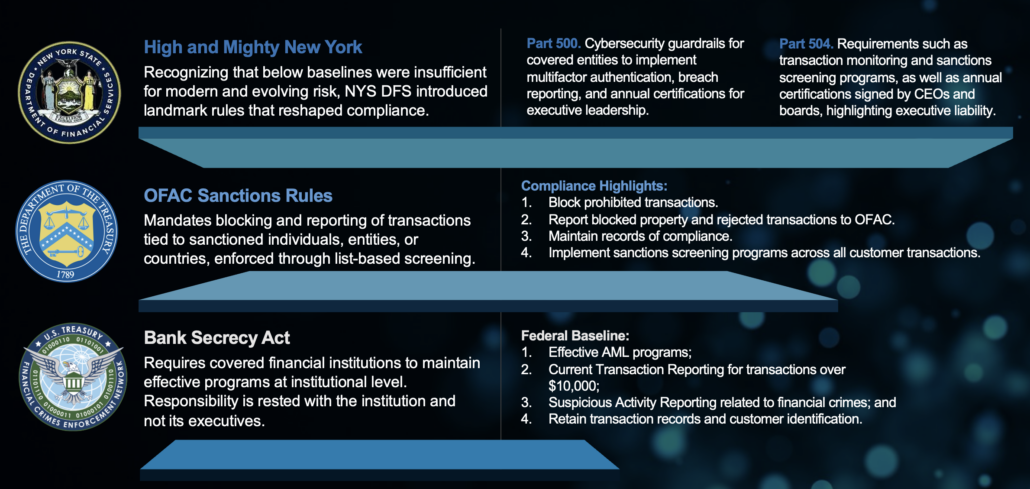
New York State of Mind: Oversized Global Regulatory Presence
New York’s regulatory reach extends far beyond its borders. Being the epicenter of US and global finance, any institution holding a New York banking license or operating a New York branch is subject to NYS DFS oversight. This jurisdictional hook has allowed New York to impose record fines on foreign banks for AML and OFAC violations: The following identify New York’s position:

The Compliance Hurdle in IPOs
Over the past two (2) decades, enforcement actions in New York have consistently reshaped the expectations placed on New York regulated financial institutions. “Serious deficiencies” warnings in AML and sanctions programs brought sharper scrutiny to risk management practices as companies aim seek public listings through an initial public offering (IPO). Post-IPO, New York has delivered a sharper message: When companies grow fast, especially on the road to an IPO, their risk profile grows even faster and failing to scale compliance alongside such growth is a compliance and governance failure.
Today, enforcement language emphasizes the necessity of scaling controls in tandem with business expansion, embedding governance and a culture of compliance as non‑negotiable components. This progression illustrates how enforcement has moved from identifying gaps to demanding structural accountability, setting the tone for how regulated financial institutions must prepare for an IPO.
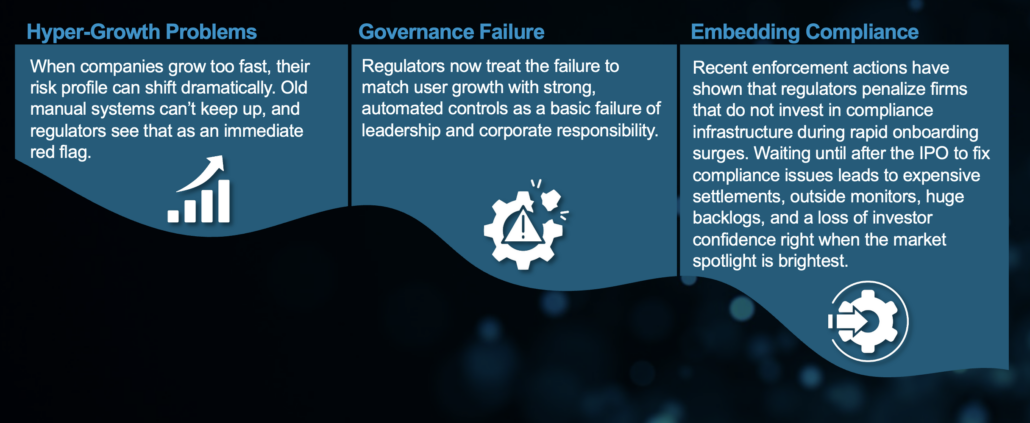
From Hurdles to Stringent Governance Accountability
As covered entities transition from hyper-growth to IPO, compliance shifts from an internal challenge to regulatory scrutiny. Enforcement actions by NYS DFS not only shape operational risk but also appear in mandatory Securities and Exchange Commission (SEC) filings as material disclosures. Between 2021 and 2023, corporate filings evolved from treating NYS DFS as a licensing risk, to recognizing it as a governance benchmark and supervisory authority.

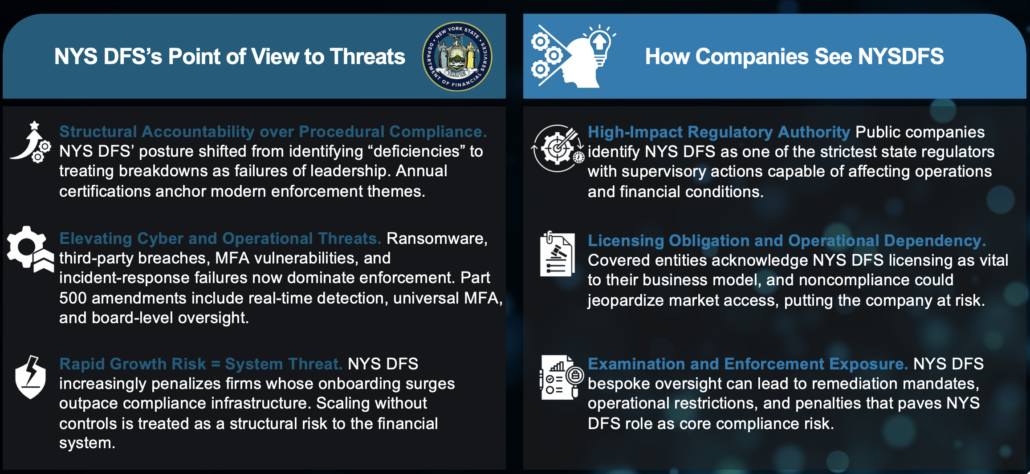
Threat Landscape in New York’s Eyes
New York has redefined the compliance narrative by shifting from identifying programmatic “deficiencies” to treating lapses as governance failures. Early enforcement built the foundation with Parts 500 and 504, targeting weak monitoring systems and rising cyberattacks. Over the years, the language of enforcement has sharpened. Regulators frame compliance breakdowns as leadership failures, penalize firms for inadequate cyber resilience, and demand board‑level accountability.
Likewise, enforcements are recognized in regulatory disclosures, treating NYS DFS as one of the most consequential state regulators and penalties are described as significant operational and reputational risks. For regulated financial institutions, NYS DFS is seen as an authority at a governance level, not just a compliance reviewer.
The Cybersecurity Shield: Absolute Zero-Tolerance
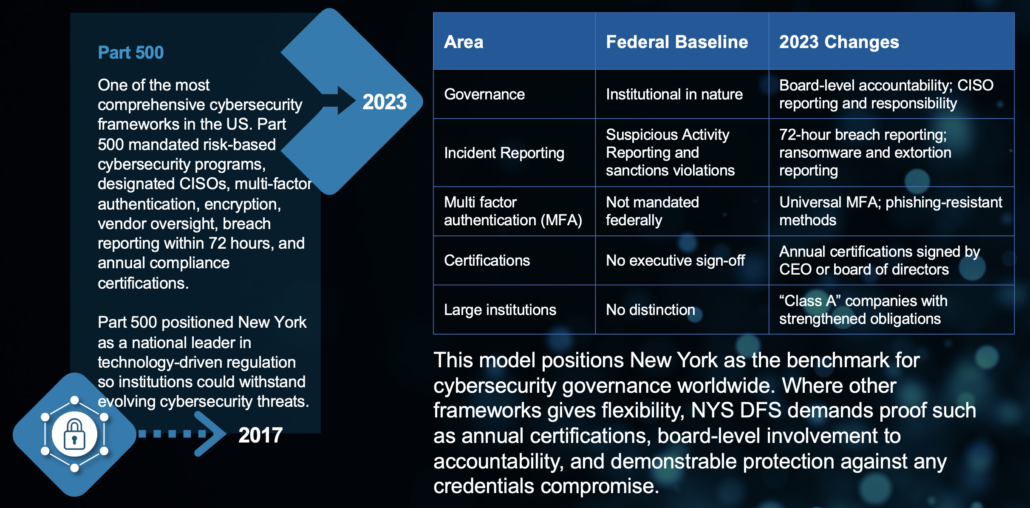
New York’s regulatory evolution did not halt at financial oversight. Rather, it extended into the digital core of financial operations. With 23 NYCRR Part 500, the NYS DFS established the nation’s first comprehensive cybersecurity regulation, transforming data protection from a best practice into a legal mandate. The Second Amendment to Part 500 further elevated this framework, closing gaps that federal guidance like the Federal Financial Institutions Examination Council (FFIEC) IT Manual left open.
New York’s Way of Doing Business
The rise of New York’s regulatory presence pose stricter requirements to financial institutions operating in or through the state. The heightened obligations, while burdensome, offer areas of opportunity. Financial institutions that embrace the standards gain reputational credibility, access to New York’s financial markets and significant customer population, and a competitive edge in jurisdictions adopting similar rules.
The same regulatory presence reshaped the global compliance landscape. New York’s cybersecurity rules became a model for other states and countries. The BitLicense sparked international debate and inspired regulatory frameworks abroad. Sanctions enforcement demonstrated that state‑level regulators could impose penalties rivaling federal actions. For financial institutions, this meant that operating in New York was not just about meeting local requirements but also falling into alignment with a global standard of statutory framework and oversight.
25 years after the USA PATRIOT Act, New York has established a significant presence in AML, sanctions, and cybersecurity requirements of regulated financial institutions operating in New York that compliment, supplement, or go beyond federal requirements.

RISK | STRATEGY | CYBER COMPLIANCE MANAGEMENT