Part 4 – Technology Expands into Financial Services Accelerating Digital Finance and Creating Dynamic Data Footprints
From Paper Trails to Predictive Algorithms: The Recurring Gap Between Innovation and Regulation
Financial-crime regulation has consistently followed technological change rather than anticipated it. Three overlapping cycles have reshaped anti-money laundering (AML) and countering the financing of terrorism (CFT), Bank Secrecy Act (BSA), and sanctions law since the 1990s: (1) computers and the internet (1990s–2001), (2) digital payments and blockchain (2000s–2020s), and (3) artificial intelligence (AI) (2020s–present). The technology changes, but the pattern remains: innovation creates new vulnerabilities, financial crime adapts, and regulation responds.
2001: The Turning Point
The September 11 attacks exposed a critical convergence: financial networks, modern communication systems, and global movement of funds could be exploited to facilitate transnational terrorism. The Uniting and Strengthening America by Providing Appropriate Tools Required to Intercept and Obstruct Terrorism (USA PATRIOT) Act of 2001 (USA PATRIOT Act) transformed the regulatory response by bringing financial crime, technology, and national security into a more integrated framework. It expanded the government’s ability to trace financial transactions, access financial and electronic records, and disrupt illicit financial flows associated with terrorism and money laundering.
Technology Significantly Expands the Data Footprint
The pattern did not end with the USA PATRIOT Act. As financial technology evolved and new forms of illicit activity emerged, regulators repeatedly adapted the legal and compliance framework to address new risks. The emergence of digital platforms enabled access to extensive customer data to provide support in meeting regulatory obligations.
2001: Technology, Finance & National Security Converge
The USA PATRIOT Act connected the financial system to the emerging realities of a technology-driven threat environment. Its provisions expanded access to information, strengthened identity controls, and modernized investigative capabilities—creating a broader framework for following the money, the people, and the communications behind financial crime and terrorism.
-Section 314: Information Sharing:
Created mechanisms for financial institutions and government to exchange information on suspected money laundering or terrorist financing.
-Section 361: Formalized the Financial Crimes Enforcement Network (FinCEN) as a Treasury Bureau
Strengthened FinCEN’s statutory authority and role as the US financial intelligence unit responsible for combating money laundering and terrorist financing.
-Section 214 & 216: Electronic Investigative Tools:
Expanded pen-register and trap-and-trace authorities to cover electronic communications, including email, modernizing investigative tools to reflect the growing use of digital communications in financial and criminal investigations.
-Section 326: Customer Identification Program:
Established customer identification program (CIP) requirements for banks, strengthening the link between identity, account, and transaction.
Technology Impact:
Advances in technology allowed for the use of secure email, document sharing and portal access systems, and messaging, among others, to efficiently and effectively share information.
25 Years: Technology Advances from Ledgers to Logins

Wallet Evolution: From Bifold to Passcode, What’s in your Wallet?

Technology Facilitates Rapid Advancements in Financial Services
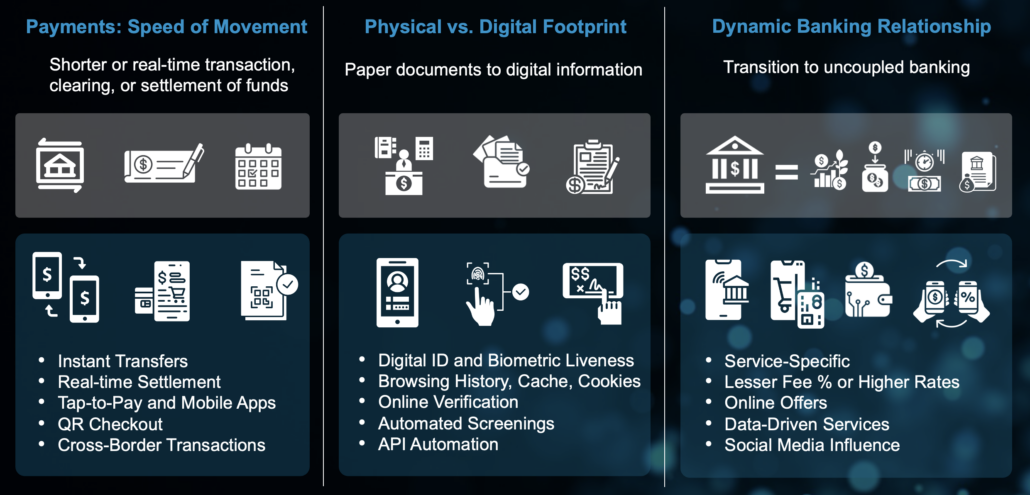
Technology reshaped banking by moving from branch-based systems to application programming interface (API)-driven digital platforms. Customers prioritize speed and convenience, preferring mobile apps, online transfers, and contactless payments. At the same time, social media accelerates the shift by broadcasting instant feedback on products and services, directly influencing customer decisions when opening accounts or conducting transactions.
25 Year Data Snapshot from Static to Dynamic Footprint
Under the USA PATRIOT Act’s original CIP standard, compliance relied on a fixed set of documents, a static, point-in-time verification model. Today, identity has become a continuous data stream rather than a fixed file, encompassing biometric authentication, geolocation, digital payments, behavioral monitoring, and social activity. Compliance programs built on the original documentary static standard now face a customer profile that is dynamic, constantly generated, and with an extensive data footprint.

Dynamic Footprint: Too Much Information to be Effective?
The various amount of customer data collected through different methods and channels can pose as an opportunity or challenge to compliance teams. When data is not effectively shared and operationalized, it remains siloed, limiting the compliance team’s insights for the detection of risks and hinder efficient compliance functions. The challenge is whether compliance teams have access to all the customer dynamic data and utilize it effectively in their due diligence, monitoring, and reporting requirements.

25 Years Later, Technology Continues to Shape Financial Services
Technology is reshaping the regulatory and operating environment for financial institutions. The reliance on manual processes and limited data to perform compliance obligations has declined. Technology has opened new opportunities and challenges for financial institutions in strengthening their oversight and risk management practices.
The underpinnings of the USA PATRIOT Act will be challenged in the next evolution of financial services. Expansion in the digital assets marketplace continues, while AI is an emerging critical driver with real use cases rolling out and broad-scope adoption on the horizon. Network heavy reliance and persistent cyber threats have necessitated the appointment of a dedicated Chief Information Security Officer (CISO), like the establishment of the Compliance Officer requirement under the BSA.
Finally, technology firms are embedded in the regulated financial services marketplace and now are acquiring community banks to fast-track access to bank charters that provide a broader opportunity for customer acquisition and growth.


RISK | STRATEGY | CYBER COMPLIANCE MANAGEMENT