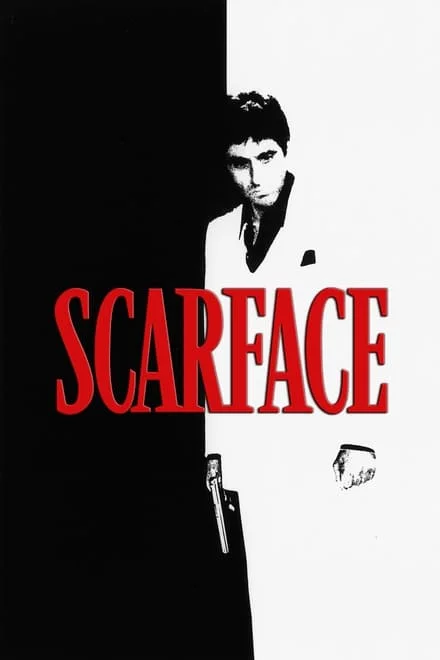
Scarface (1983)
Drug Kingpin Places, Layers, and Integrates the Proceeds of Cocaine Sales During Miami’s Drug Wars
Scarface, the crime thriller about a Cuban immigrant turned drug kingpin, provides a glimpse into the 1980’s Miami drug wars. Antonio Montana (aka Tony) arrives in Miami during the Mariel boatlift, the mass exodus of Cuban emigrants from Cuba’s Mariel harbor to Key West, FL, which started in April 1980 and resulted in more than 100,000 Cuban refugees hitting the US shores.
After Tony arrives in the US, he is questioned by US authorities about his criminal past and placed in a refugee detention center known as Freedom Town. From there, Tony is looking for opportunities in the US for money, which leads to power, which leads to women. He agrees to help his friend, Manny Ribera (Steven Bauer), with a paid hit ordered by Omar Suarez (F. Murray Abraham), drug lord Frank Lopez’s (Robert Loggia) confidant, to kill Emilio Rebenga (Roberto Contreras), one of Fidel Castro’s most trusted generals, in exchange for green cards. After the successful hit, Tony and Manny work as a dishwasher and cook at El Paraiso when they are approached by Omar to help with unloading marijuana off a boat.
Tony, the dishwasher, objects to the price Omar offers to unload the boat as too low and feels disrespected after proving his value with the Rebenga hit. After Tony pushes for more money and provides his knowledge on the market price for unloading a boat, Omar gives Tony and Manny an opportunity to work their way up and ‘make big bucks’ by completing a cocaine buy with a bunch of Colombians at a hotel on Ocean Drive in Miami Beach. The buy goes awry with the unequal match of bringing a chainsaw to a machine gun fight.However, Tony and Manny walk away with the 2 kilos of yeyo (aka cocaine) and the original buy money provided by Omar. Tony refuses to give both to Omar, rather, in a power move, he brings both directly to Frank at his home. Thereafter, Frank rewards Tony and Manny with dinner at the Babylon Club, a nightclub that attracts all the drug traffickers, and offers him to help on a future job of using mules coming from Colombia. Mules are persons who act on behalf of another for compensation to move illegal goods, whether drugs or cash derived from drug sales, etc. Omar tells Frank he considers Tony to be a peasant, however, Frank believes he can elevate Tony and he will be loyal as a result.
Subsequently, Tony accompanies Omar, on behalf of Frank, to meet with Alejandro Sosa (Paul Shenar) at his cocaine production facility in Cochabamba, Bolivia. Tony overhears Sosa telling Omar he has an issue with finding a steady buyer for his supply and wants to split the risk. At lunch, Tony starts to negotiate with Sosa on how to be that buyer and share the risk on delivering the cocaine to the US. However, Omar makes Sosa aware he is only authorized by Frank to buy a certain amount and Tony is speaking out of turn. Shortly thereafter, Sosa small talks Omar into heading back to Miami, however, he invites Tony to stick around and talk more business. Unfortunately, Omar does not survive the helicopter flight home as Sosa learned he was a police informant.
Afterwards Tony partners with Sosa directly to take a larger role in the drug trade, he ends up with an abundance of cash as his cocaine business booms. To wit, Tony and his crew walk right into Tri-American City Bank in Miami, FL with several large olive-green military-style duffel bags filled with cash from the cocaine sales. Like many Miami banks at that time, Tri-American City Bank was more than happy to let Tony place his cash at the bank for a healthy fee. Tony also needed businesses and large purchases to layer and integrate his money, so he established several companies in Miami, namely along Brickell Avenue and West Flagler Street, such as Montana Management Co. and Montana Travel Co., funded his sister’s extravagant hair salon, Gina Montana’s Beauty Salon, buys a mansion, hosts his elaborate wedding, and of course, acquires a tiger as a pet.
Eventually, the banker (Dennis Holahan) at Tri-American City Bank has a sit down with Tony at his mansion. A typical business meeting for the time, however, today an established practice under enhanced due diligence (“EDD”) requirements for relationship managers (“RMs”). Under EDD, RMs are required to meet with their high-net-worth private bank clients at their principal place of business and/or residence and document the meetings using call reports to support the ongoing business relationship with the bank.
At the meeting, Tony wants a rate reduction since he is now depositing $10-$15million per month, whereas the banker tells Tony that he needs to raise his rates because Tri-American City Bank is a ‘legitimate bank,’ he needs to offset the risk of taking that much cash, the IRS is coming down heavy, and he alludes to a Time Magazine story on South Florida. (On November 23, 1981, Time Magazine published South Florida: Trouble in Paradise with the cover story headline of Paradise Lost? South Florida). Manny and Tony threaten to move the money to a bank in the Bahamas, however, the banker counters as to whether Tony will trust keeping his money their long term. Rather, Tony should stay with Tri-American City Bank as an ‘old and well-liked customer’ and ‘he is in good hands with us.’
Interestingly, in the early 1980’s, money laundering was not a US federal crime. While the Bank Secrecy Act (BSA), which was established in 1970, created recordkeeping requirements for financial institutions and currency transaction reporting (CTR) requirements for cash transactions more than $10,000 in a single day, state and federal law enforcement were understaffed and lacked training in following the money. At that time, enforcement of the BSA by the banking regulators was non-existent and the banks rarely complied with CTR reporting, arguing that such reporting and inquiring into customers was the job of law enforcement. Moreover, the onslaught of cocaine and marijuana purchased with cash and the international nature of drug trafficking and financial movements overwhelmed the US banking system during the US savings and loan (S&L) crisis with record high inflation rates between 14-20%.
In response to significant illicit finance and weak federal laws, the US passed the Money Laundering Control Act of 1986, which included the very powerful Title 18 USC §1956 and 18 USC §1957 that prohibit knowingly engaging in financial transactions using funds derived from a specified unlawful activity (SUA). More specifically, §1956 generally, investigations do not require a dollar amount limit and do not require that a financial institution be involved. Whereas §1957 prohibits monetary transactions over $10,000 or an aggregate of money transactions over $10,000 of criminally derived funds obtained from a SUA while utilizing a financial institution. Today, most federal money laundering investigations charge the defendant(s) with violating §1956 and/or §1957.

The Wire: Season One
Follow the Drugs Shifts to Follow the Money
Jack Ryan: Season One
Transaction Analysis Reveals Suspicious Activity of International Wire Transfers Funding a Terrorist Attack
The Night Manager
Trade-Based Money Laundering Used to Conceal Corrupt Arms Deal
The Beekeeper
Large-Scale Tech Support Scam Disguised as a Call Center Preys on Elderly Victims to Fund a Presidential Campaign

RISK | STRATEGY | CYBER COMPLIANCE MANAGEMENT