Part 5 – US Regulators Significantly Increase Enforcement for BSA Compliance Violations

The Foundation of AML Enforcement
The Bank Secrecy Act (BSA) established the foundation of the US anti-money laundering laws by mandating financial institutions to keep records, report selected transactions, and cooperate with police to identify illegal financial activities. Following the terrorist attacks on September 11, 2001, Congress passed the USA PATRIOT Act to strengthen the existing AML framework by expanding regulatory powers, setting up new compliance regulations, and improving the fight against money laundering and terrorist financing. Since then, BSA enforcement actions have driven compliance across banks, money services businesses, securities firms, insurance companies, and casinos, with penalties ranging from millions to billions of dollars.
The Evolution of Regulatory Expectations
The USA PATRIOT Act marked a significant shift in the supervisory approach to AML compliance. Regulatory expectations evolved beyond technical adherence to statutory requirements toward evaluating the effectiveness of enterprise-wide AML governance, risk management, customer due diligence, transaction monitoring, sanctions compliance, and board oversight. Enforcement actions became an important supervisory tool for communicating regulatory expectations and promoting continuous improvements across the financial sector.
Why Enforcement Actions Matter Today
Today, enforcement actions serve not only to address violations of law but also to reinforce sound governance, accountability, and effective risk management. Over the past two decades, supervisory findings have influenced how financial institutions design AML programs, invest in compliance capabilities, and strengthen financial crime controls. These developments continue to shape both US regulatory practices and international AML/CFT standards.
The Framework and Its Fault Lines
A. Title III Becomes Law
The International Money Laundering Abatement and Anti-Terrorist Financing Act of 2001, also known as “Title III” of the USA PATRIOT Act, strengthened the US AML Framework by amending the BSA and related federal money-laundering laws. It mandated statutory customer identification requirements, enhanced due diligence for certain foreign correspondent and private banking accounts, and prohibited US correspondent accounts for foreign shell banks, thereby transforming key AML controls into explicit, codified requirements subject to regulatory oversight and examination.
B. Riggs Bank: The Early Warning
In 2004, the Office of Comptroller of the Currency (OCC) and Financial Crimes Enforcement Network (FinCEN) fined Riggs Bank $25 million, the largest BSA penalty against a US bank at the time, for systemic AML failures involving high risk accounts linked to Augusto Pinochet and Equatorial Guinea. Riggs failed to conduct adequate due diligence, monitor suspicious activity, and file timely SARs. The case became a landmark example of PEP risk and the need for effective, risk-based AML controls.
C. A Threshold Frozen Since 1972
Set by Treasury regulation in 1972, the $10,000 CTR threshold has never been adjusted for inflation and remains unchanged today. A 2024 GAO report calculated its 2023 equivalent at roughly $72,880. More than 20 million CTRs are now filed annually, creating significant compliance burden. The Anti-Money Laundering Act of 2020 required Treasury to review CTR requirements and consider whether the threshold should be adjusted.
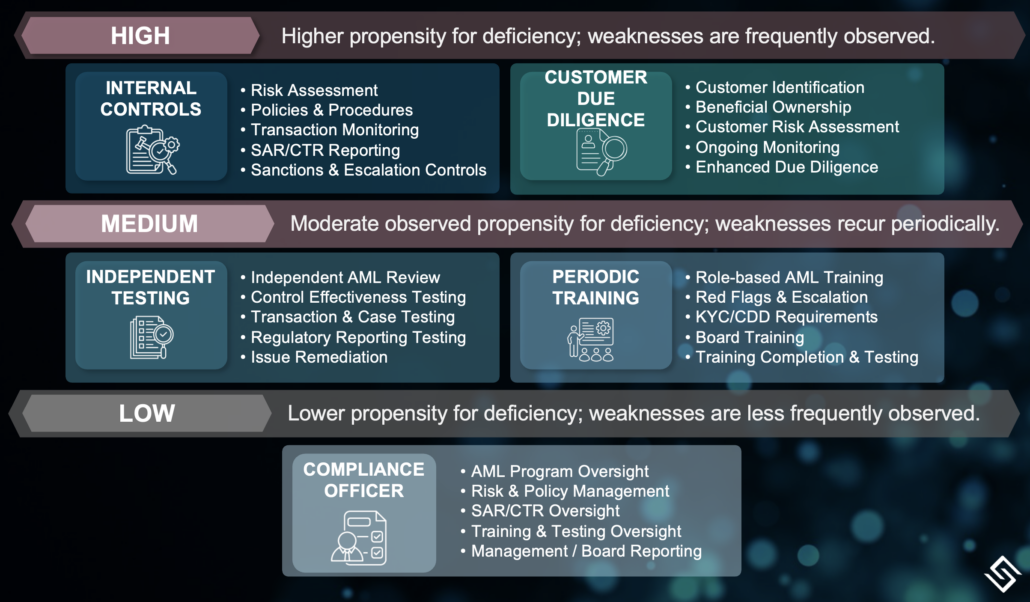
Relative Deficiency Risk Based on US Enforcement Trends
US enforcement actions have highlighted recurring AML program weaknesses over the past 25 years. Relative prevalence is based on enforcement trends from FinCEN and other US regulators, supplemented by findings from US Treasury’s 2026 National Money Laundering Risk Assessment (NMLRA). The ratings below are analytical assessments and do not represent formal regulatory risk classifications:
The Turning Point: Where The First Cracks Gave Way
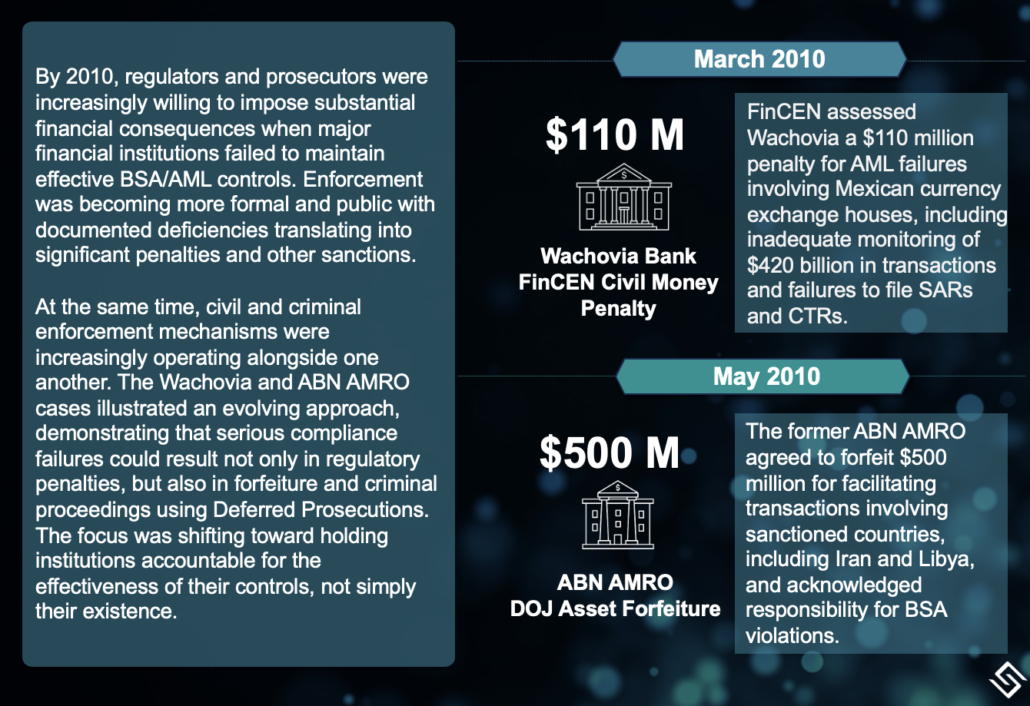
The Case That Reshaped Enforcement
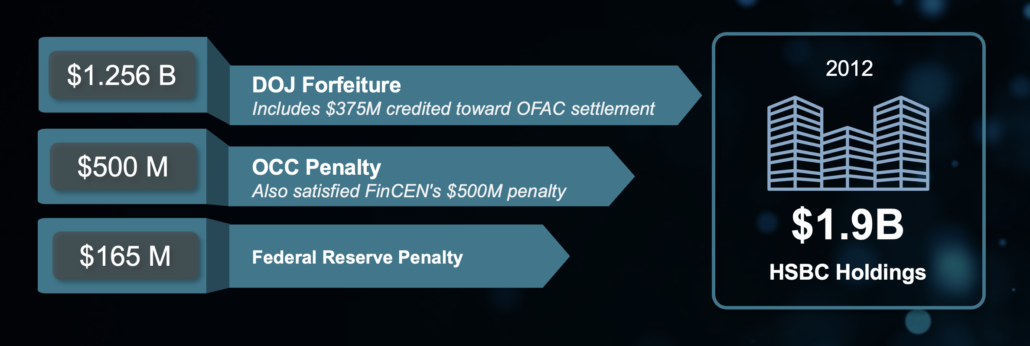
HSBC became a defining case in the evolution of financial crime enforcement. In 2012, the bank agreed to a coordinated resolution totaling approximately $1.9 billion, including a five-year Deferred Prosecution Agreement, after AML failures allowed at least $881 million in drug trafficking proceeds linked to Mexican and Colombian cartels to flow through its US operations.
The resolution also addressed sanctions violations involving Cuba, Iran, Libya, Sudan, and Burma. It combined forfeiture, civil penalties, enhanced compliance obligations, and independent monitoring. More importantly, it helped reshape how regulators and prosecutors approached serious compliance failures at major global financial institutions.
The Shift Toward a Culture of Compliance
BSA/AML enforcement increasingly shifted from individual violations to the effectiveness of an institution’s overall compliance framework. In 2014, FinCEN formalized this broader focus through its “Culture of Compliance” guidance seeking to escalate compliance to a larger governance role.

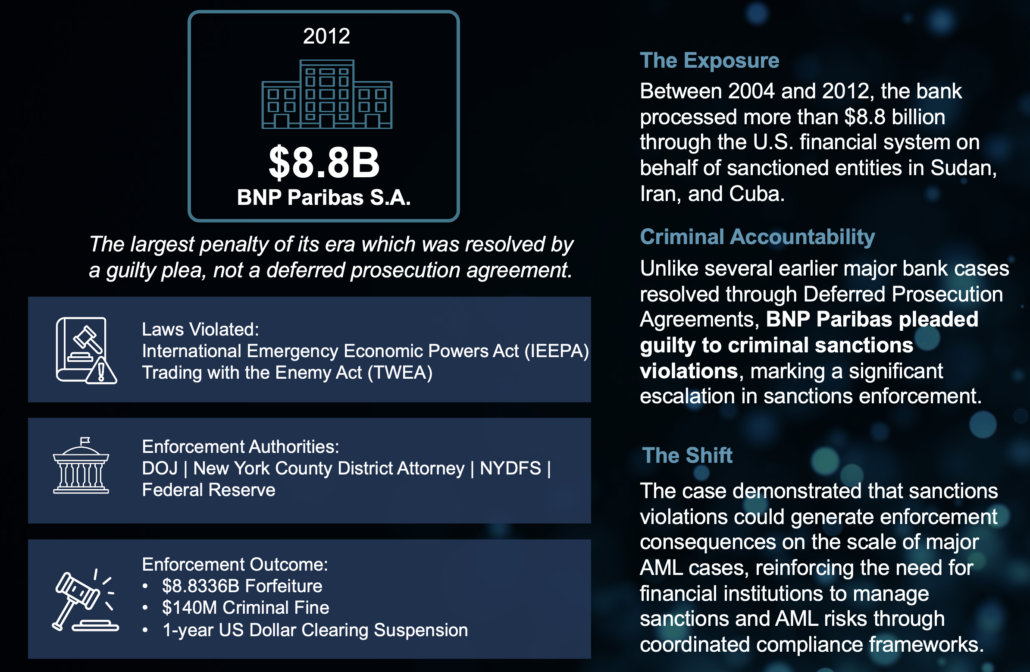
The Sanctions Enforcement Shift: 2012
Beyond Borders: The Reach of US Enforcement
Between 2007 and 2015, Danske Bank’s Estonian branch processed approximately €200 billion through its non-resident portfolio, much of it involving high-risk customers and transactions that raised significant money laundering concerns.

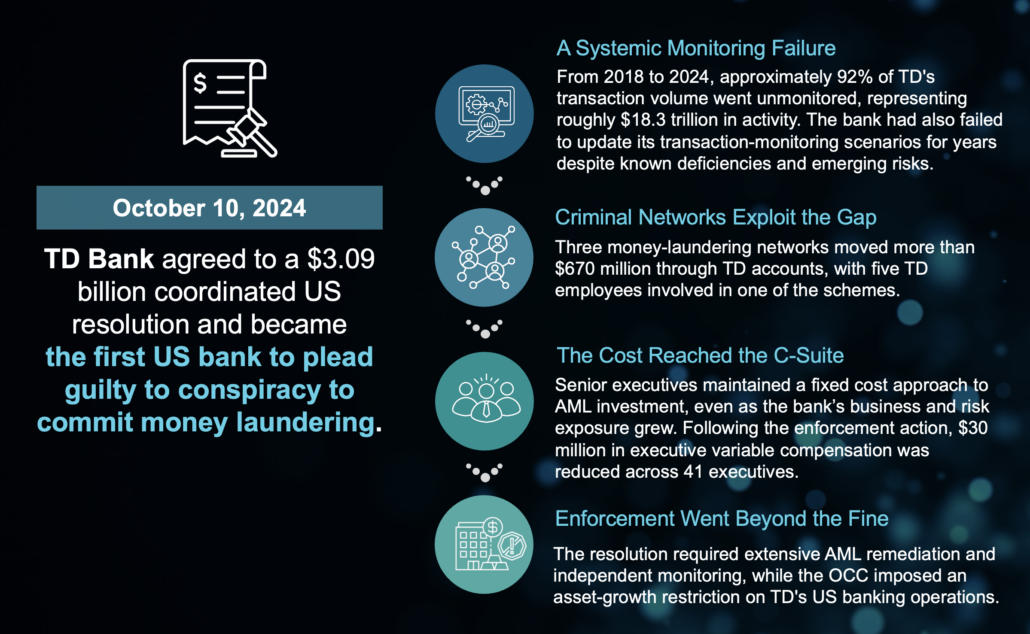
The $3.1B Cost of AML Failure
25 Years Later: Persistent AML Control Failures
25 years after the USA PATRIOT Act, persistent AML failures highlight a continuing gap between regulatory requirements and effective implementation. Strong laws must be matched by robust controls, adequate resources, and effective oversight.

From Penalties to Accountability
The trajectory of major AML enforcement reflected a shift from monetary punishment alone toward a broader accountability model, combining significant penalties with criminal, structural, and individual consequences.

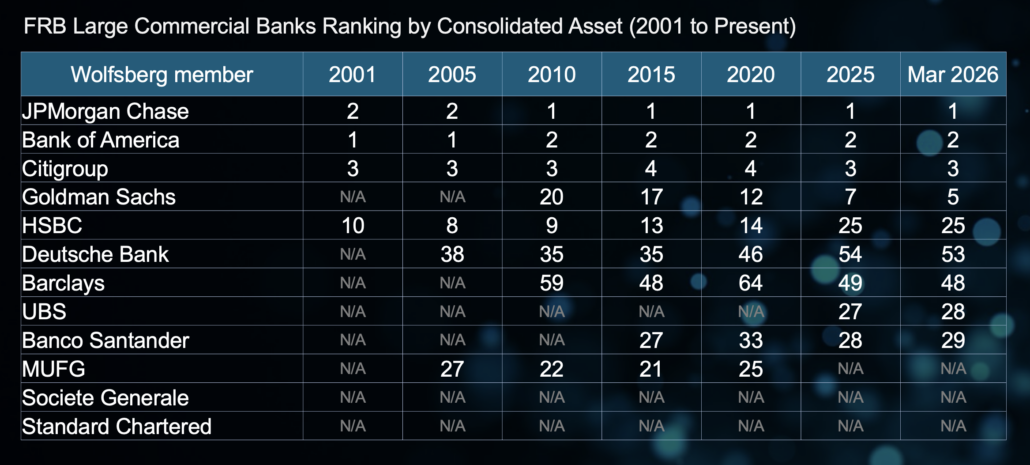
Each Wolfsberg Group Member Bank Has Been Penalized for AML or OFAC Non-Compliance
The Wolfsberg Group, started in 2000, is an association of 12 member banks that develops frameworks and guidance for the management of financial crime. In 2001, the Group published AML Principles on Private Banking and later expanded the same framework for the AML Principles for Correspondent Banking, serving as initial foundation building guidance.
More importantly, the Group created the Correspondent Banking Due Diligence Questionnaire, which is series of AML questions to be completed by foreign banks as part of the onboarding and ongoing due diligence process. Interestingly, since the USA PATRIOT Act each of the 12 member banks has received a penalty from FinCEN, federal bank regulator the OCC, NY bank regulator NY DFS, or OFAC.
“The Wolfsberg Group is an association of 12 member banks that develops frameworks and guidance for the management of financial crime risks. The financial crime risk management and compliance sphere continues to evolve rapidly. As the leading voice in banking committed to combatting financial crime, the Group’s approach is to leverage the depth of experience of our members to provide practical guidance developed by practitioners for practitioners and improve the effectiveness of financial crime risk management and compliance.” – The Wolfsberg Group
Even the Largest Banks Remain Exposed
Despite their longstanding importance within the US banking system, Wolfsberg member banks have continued to face BSA/AML risks over the past years. During this period, member institutions have been subject to regulatory enforcement actions and financial penalties for deficiencies in areas including transaction monitoring, suspicious activity reporting, customer due diligence, internal controls, and overall AML program effectiveness. This demonstrates that size, market prominence, and sophisticated compliance infrastructure do not eliminate the risk of AML control failures.
Regulatory Penalties Across Wolfsberg Member Banks
Over the years, regulatory enforcement has left a measurable financial footprint across the world’s leading banks. Looking across these actions reveals not just the scale of penalties, but also the recurring areas of regulatory concern, from AML and sanctions to broader compliance and risk management.

The New Enforcement Reality
The USA PATRIOT Act fundamentally expanded the US AML framework, strengthening customer identification, due diligence, information sharing, and law enforcement and regulatory authorities. Over the two decades that followed, these foundations evolved alongside increasingly sophisticated financial crime risks and more consequential enforcement actions.
The cases that followed show how far that framework has developed. What began with stronger AML requirements and regulatory tools evolved into an enforcement regime capable of imposing billions in penalties, criminal liability, structural restrictions, enhanced oversight, and individual accountability. The lesson is clear: the USA PATRIOT Act changed the rules; two decades of enforcement changed what compliance means.
Regulators continue to emphasize:
– Effectiveness over formality
– Risk-based supervision
– Data, technology, and analytics
– Senior leadership accountability
– Cross-border and sanctions risks
Financial institutions continue to adapt to:
– Increasingly sophisticated financial crime typologies
– Higher expectations for transaction monitoring and customer due diligence
– Technology-driven compliance
– Greater integration of AML, sanctions, fraud, and financial crime controls
– Increasing regulatory scrutiny and personal accountability
25 Years Later: Enforcement is becoming more data-driven, targeted, and consequential, with greater scrutiny of AML effectiveness, technology, governance, resources, cross-border activity, and individual accountability.
The direction is clear: AML enforcement is moving from proving that controls exist to proving that they work.

RISK | STRATEGY | CYBER COMPLIANCE MANAGEMENT